Enterprise applications require environments that guarantee zero downtime and absolute data security. This playbook outlines the Verpex Solutions baseline for deploying robust, load-balanced server infrastructure on AWS.
1. Core Network Topology
Relying on a single server introduces an unacceptable single point of failure for enterprise workloads. While the architecture below represents our standard highly available baseline, it is not a rigid constraint. We actively architect and scale network topologies to perfectly align with specific client requirements, performance targets, and operational budgets.
The Verpex Standard
- NGINX Load Balancer: All public internet traffic is strictly routed through an NGINX load balancer. This handles SSL termination and delegates requests to healthy downstream nodes.
- Primary and Secondary Web Servers: The application runs across a minimum of two web servers. If the primary server experiences a spike in resource consumption or fails a health check, the load balancer automatically delegates traffic to the secondary server.
- Master and Slave Database Cluster: The data layer is decoupled from the web servers. We utilize a Master DB for all write operations and a Slave DB for read replication and instant failover capabilities.
2. Hardened Linux Security Policies
Infrastructure is only as strong as its weakest access point. We apply aggressive security policies at both the cloud network layer and the operating system level.

The Verpex Standard
- No Root Access: Direct root login via SSH is permanently disabled on all Linux instances. Engineers must log in using individual user accounts with cryptographic keys and escalate privileges only when explicitly required.
- AWS Firewall (Security Groups): Web servers and database servers reside in private subnets. We configure AWS Security Groups to drop all traffic by default. SSH access is restricted exclusively to whitelisted IP addresses belonging to authorized developer machines.
- Proactive Patch Management: Servers are actively monitored for vulnerabilities. We enforce a strict schedule for applying Linux security patches and critical package updates without disrupting the load-balanced application.
3. Observability and Logging
You cannot secure or scale what you cannot see. Complete system visibility is a mandatory requirement for any enterprise deployment.

The Verpex Standard
- Prometheus Metrics: We deploy Prometheus node exporters on every server to continuously scrape real-time metrics regarding CPU utilization, memory consumption, disk I/O, and network bandwidth.
- Grafana Dashboards: All Prometheus data is aggregated into centralized Grafana dashboards. This provides our engineering team with a visual, real-time pulse of the entire AWS ecosystem.
- Centralized Logging: NGINX access logs, application error logs, and system security logs are aggregated to a central repository to enable rapid auditing and debugging.
- Automated Alerting: We configure threshold-based alerts. If a server experiences abnormal traffic spikes or disk space drops below safe levels, the infrastructure automatically pages the relevant engineers before users are impacted.
4. Durable Storage and Data Lifecycle
Server disks are the wrong place for data that only ever grows. Photos, documents and uploads belong in storage that scales on its own, protects itself and gets cheaper as files age.
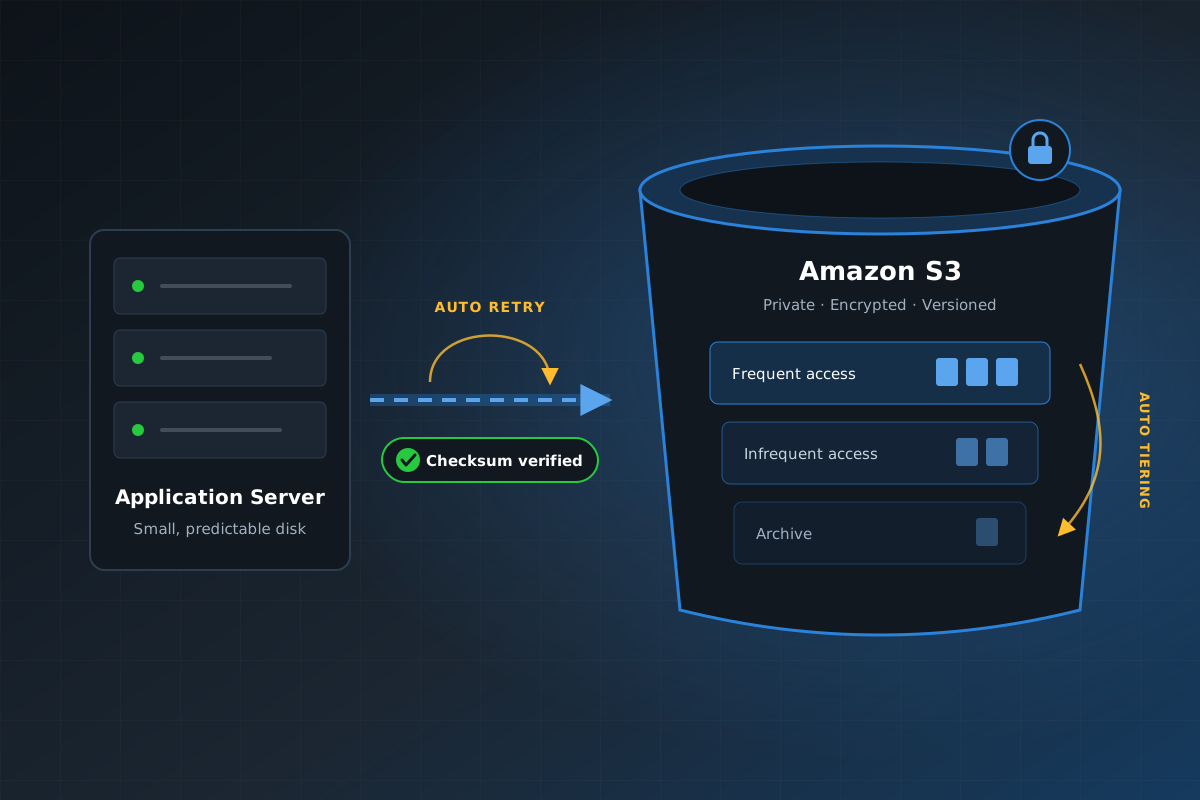
The Verpex Standard
- Files and Media Live in Amazon S3: User uploads and media are stored in S3, not on server disks. We pay only for what is stored, space is practically unlimited, and server disks stay small and predictable.
- Every Copy is Verified: A file only counts as safe once its checksum matches the cloud copy. Failed copies are retried automatically, and a daily health report confirms that everything arrived.
- Private and Encrypted by Default: Buckets are never public and are reachable only by our application servers. Data is encrypted at rest, and versioning allows deleted or overwritten files to be recovered.
- Automatic Cost Tiering: Files that are rarely opened move to cheaper storage classes on their own, and come back instantly when needed.
- Safe Clean Up: A local copy is only removed once its cloud copy has been verified byte for byte.
See this standard in action: Unlimited Media Storage in a Day, the case study of how we moved a growing platform's media to S3 and cut projected storage costs by around 15 times.